

Diablo IV
Suggested Page Title: Diablo IV | A Return to Darkness in an Open World
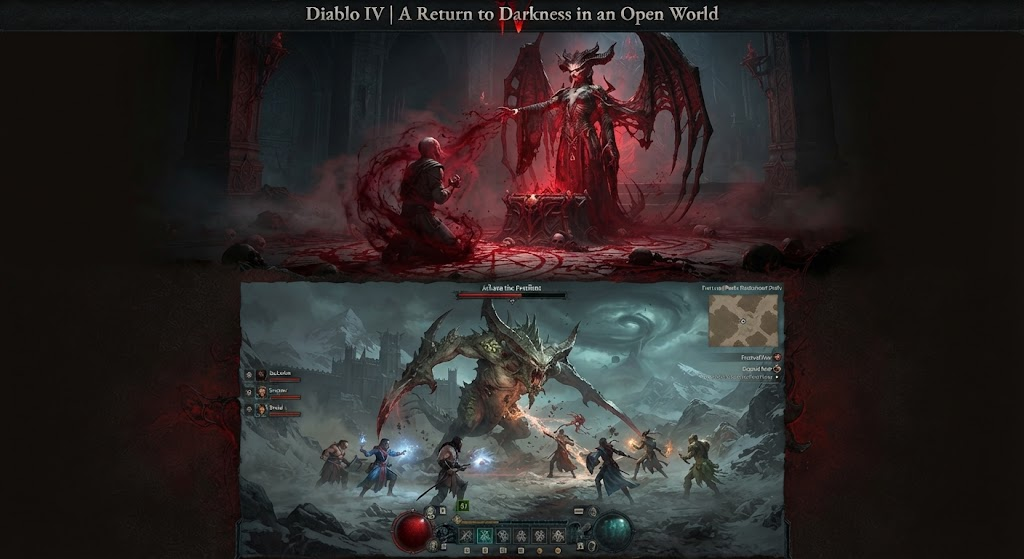
(Image Suggestions: Use the classic CG screenshot of Lilith’s blood ritual summoning at the top, and insert a real-time screenshot of the open-world map or a World Boss battle in the middle.)
Introduction
After the spectacle and controversy of the third installment, Diablo IV chose a path of “returning to the roots.” Darker tones, more visceral execution animations, and a more oppressive narrative atmosphere—Blizzard attempted to answer veteran players’ calls for “dark gothic” with this entry, while simultaneously injecting an unprecedented sense of scale into the series through a seamless open world.
Story Background: The Shadow of Lilith
The story of Diablo IV takes place decades after Diablo III. Following years of war between the High Heavens and the Burning Hells, Sanctuary’s population has dwindled, and survivors struggle to rebuild amid the ruins. However, an ancient name begins to be whispered across the land: Lilith, daughter of Mephisto and one of the legendary “Creators” of humanity. Her return is not one of salvation, but rather one that, in a deeply unsettling way, awakens the darkest malice and potential within humanity.
Unlike the linearly paced stories of the past, Diablo IV‘s narrative is dispersed across a vast world. Players can explore five distinct regions in any order, with main quests and side events interwoven across the open map, allowing the history and suffering of Sanctuary to be presented in a more natural way.
Gameplay Features: Open World and Endgame Evolution
The biggest structural change in Diablo IV is its seamless open world. Players can ride mounts across dry plains, plague-ridden swamps, and snow-capped mountains, encountering world events, stronghold assaults, and World Bosses that require multiplayer coordination along the way. This design shifted the Diablo series from being “level-driven” to “world-driven,” placing the joy of exploration back in a position of importance.
In terms of classes, the five launch classes (Barbarian, Sorceress, Druid, Rogue, and Necromancer) all feature substantial skill trees and Paragon boards, allowing players to make fine-tuned build adjustments in the endgame phase. The subsequent Vessel of Hatred expansion introduced the Spiritborn, while the latest Hatred’s King expansion brought two brand-new classes: the Paladin and the Warlock, further broadening the boundaries of class selection.
Endgame content has become richer through continuous iteration. Beyond Nightmare Dungeons and Helltides, subsequent updates introduced the “War Plans” system, allowing players to customize the order and buffs of endgame activities, transforming the loot-grinding process into a more strategic planning behavior. For a live-service game, Diablo IV is attempting to sustain players’ long-term journey in Sanctuary through continuous mechanical updates.